Archive for the ‘Advanced’ Category

Precautionary Search and Landing

Saturday, January 27th, 2007

Romeo Lima
Still no suitable weather for my first solo cross country but I am revising hard for my met exam. Richard asked if we had done precautionary search and landings. No I replied, so off to the briefing room we went.

The idea here is unlike a PFL and basically gliding down because of engine failure, you plan you landing and make it under power. Its something you would do if you needed to get down, if you thought you would not make it back to the airfield because of bad weather or bad light.

The take off was normal and we headed west further then I had been in the training area before. As we crossed the river Trent we radioed Humberside Radar and informed them what we were intending and if we could stay on there frequency and not hand over to Doncaster.

At this point I started a slow descent to 1000′ feet and started looking for a suitable field. Suddenly I spotted some movement over to my left.
“Microlight 10 O’Clock low, moving right to left.”
I announced to Richard my Instructor. A few moments later and Richard said he had them, then almost immediately Richard announced.
“Second Microlight 2 O’Clock low, following same track.”
I halted my descent and made a small turn to the left and then to right having a good look round. No one else in sight so I continued on my route.

We finally spotted a field to make the attempt. Not perfect as it was not into wind but the best we could find with all the water-logged fields around.

Having chosen my field the next step was to make three circuits, inspecting the surface and general vicinity. I slowed down and selected the first stage of flaps and descended to 500′ feet. I then made a slow circuit as if to land but on final leg keeping the field to my left to have a good look.

I then made my second inspection run. This time from 300′ feet. First I added a second stage of flap. This was more difficult. At this height I was getting turbulence and maintaining a consistent height and speed was difficult.

After passing the field on final I now descended to 100′ feet. I was now concentrating harder then I had in a long time. On each turn I increased power a little to ensure I did not lose any more speed. Stalling at this height would have be in the ground in no time at all.

With this final inspection circuit made it was now time for the mock landing. This would be landing from low height at minimum speed. The idea is you touch down at the moment of stalling. I made my approach from 100′ feet and added the final and third stage of flap. Down into the field I flew then at about 50′ feet at very slow speed Richard announced he was happy and to climb away. I applied full power, leveled off and let the speed increase. I then removed a stage of flap and climbed away at 80 knots. Wow that was intense!

I climbed up to 1000′ feet and headed back to the field via the Elsham VRP.

The rejoin was fine but my landing was poor. I misjudged the round-out. Might need to book a session in the circuit to get my hand back in.

We taxied back and shutdown. Once back at the club house Richard gave us a debrief. Now for some good weather and that solo cross country.

Nav Ex

Saturday, December 9th, 2006

Its now well into winter and lessons are being cancelled with extreme regularity, but this morning the weather really looked good. It was an early start, so a quick check over the weather to confirm and off I went.

Grass Parkway

It was a cold morning and I was delayed somewhat by having to de-ice the car. It was also a slow drive, the back roads from Caistor to Humberside Airport were also very icy.

Arriving at the club house, Richard suggested I could either head out on my own again for more solo practice or we could do a little Nav exercise. I have been reading up on my Nav and it sounded interesting. That and the small runway was covered in ice which would mean a crosswind landing. I opted for the Nav exercise.

I was told to plan for Driffield, Market Weighton and back to Humberside. A few quick lines on the map were soon drawn in routing us from the VRP Elsham. Richard gave me the wind and I soon had some speed, timings and headings on my nav log. Richard also worked them out and I was glad that they agreed. So with that we headed off to check the plane.

I went through security and found G-GALB parked close by outside the Global hanger as usual but she was covered in a light coating of ice. While I did the pre-flight Richard set to and attacked the ice with a brush, gentle clearing all surfaces of ice. With once side completed Richard asked me to stop the preflight and assist in swinging the plane round. This was soon done, and I got in the plane to finish off. At this point Richard gestured to me, to come out. I did so, and he pointed out that the port side engine cover latch was undone. Oops! In being disturbed in my checks I had not quite started back at the point I had got to. This time Richard was there to spot it. Next time I might not be so lucky. I made a mental note. If you get disturbed doing the checks go back to the beginning of that section.

Once I had redone the checks we both got in and continued through the checklist. We soon had the engine running and were tuning into the ATIS to get the latest weather, and then back to tower for the radio check and taxi instructions.

As usual we taxied to holding point Bravo and went through the power checks. Richard pointed out the the oil temp had still not reached the green and suggested we set a higher idling speed to normal and continue with the checks but miss the 2000 rpm checks until the oil temp had reached the green. With the rest of the checks complete it took another few minutes before the oil temp reached the green, and so we finally completed the last of the power checks.

With that all sorted I radioed tower for clearance and we were soon in the air heading off to Elsham, one of the Visual Reference points for Humberside. Once at Elsham we both started our stop watches and I took up my first heading.

Richard suggested at this point it might me a good idea to check the DI against the compass, as it might have shifted during the take-off. He was right, we were about 5 degrees out. Richard said I should make a habit of checking the DI during Navigation Exercises regularly and after every turn. With it also being such a cold day we put the carb heat on for a couple of minutes, just in case.

As we went along, Richard pointed out land marks and showed them to me on the map. The hard part seem to be judging the scale of everything. One town looked very much like another, trying to Navigate, flying the plane, and also keeping a listening watch on the radio all seemed like a lot of work to have to cope with. I was quite surprised to find us reaching Driffield within 30 seconds of my calculated time. Wow this Navigating lark must work!

The second leg was much like the first with an old rail way line to follow to make it easy. The third soon had us back to Elsham, exactly as per our eta.

Once we were down Richard told me to plan Humberside, York, Bridlington. We would do it together the next time the weather was suitable and then following time I would try it on my own. Glup!!!

Solo Practice

Saturday, November 11th, 2006

I had not flown since the 29th September. I had intended to do some sessions Solo and Richard my instructor agreed that solo consolidation was now a priority. The last two lessons had been cancelled due to bad weather.This morning I checked the weather. There was a front just north of us that did not look good, low cloud and gusts of wind forecast at 40 knots! But now it had been over a month since I had flown at all, I had to get in the air, even if it was dual with an instructor.

Caroline had the car today, she was running the Baden Powell Challenge for a bunch of girl guides this weekend. So I packed a change of clothes and my flight bag into the top box of the Honda Deauville and set off.

Arriving at the club house I was alarmed to find a little Cessna C150, making a very scary landing. In the club house I found that Richard was already up with a student, so I studied the weather and listened to the ATIS. The wind was moving from 230-250 degrees and blowing at between 16-20 knots with the odd gust of 20-25 knots, with cloud at 3500 feet.

As I continued to wait some dark low cloud started to blow in. I checked the ATIS again and they still reported cloud base at 3500 feet. That I did not believe.

Richard finally arrived with the student and they announced that it was flyable but very turbulent in places. Richard sent me off to preflight the plane while he debriefed the student.

I went through security and found G-GALB parked close by outside the Global hanger. Preflight did not take long and noticed they had fixed a number of issues since last I flew so we had a nearly perfect plane. The only fly in the onintment was that the red rotating beacon was not working. The best thing about G-GALB was it had some very advanced avonics. Its nice to play with new toys!

Richard soon joined me in the co-pilots seat and I finished the preflight and started the engine. No prime needed as it was already warm. I checked the ATIS again and this time they reported cloud at 3000 feet, I still did not believe. It looked far closer then that.

I retuned the radio to Humberside Tower and requested permission to taxi.
“Humberside Tower, good morning, Solo02 outside Global. Request Radio check and Taxi. I have information Papa with a QNH of 1012.
I was soon answered.
“Solo02, information Papa correct, QFE is 1016, taxi to runway 21, hold at Bravo.

With that I closed the throttle, took off the brake and put a little power on. As we started to move I gave it full left rudder to swing us round and miss the jet provest that was parked in front of us. As I taxied to the holding point I was given a transponder code of 4260, which I wrote down but Richard kindly set on the transponder as standby.

I pulled up just before holding point Bravo, and started my power checks. Then my take off checks, and finally back onto the radio to get permission to take off.
“Humberside Tower, Solo02, ready for departure.”
“Solo02, cleared to take off, left hand circuit.”

Clearance straight away, that made a change. I had Richard switch the transponder from standby to ALT and I reached forward to take off the brake. I quickly swung round went passed the holding point and lined up on runway 21. I quickly checked the DI against the compass and made a small correction, then it was time to go.

Take Off

I took my feet off the toe brakes, and placed my hand on the throttle. Pushing forward I increased power gradually to full.

With the stiff wind I had to apply in to wind ailerons together with right rudder to keep us straight on the runway, at sixty knots we left the runway and I increased the rudder pressure and leveled the ailerons. At 500 feet I made a gentle turn, with the wind only about 60 degrees instead of the normal 90 degrees.

From there it was a normal circuit but it was a very turbulent circuit and it was hard work keeping everything on track. I got the downwind call in but Richard had to remind me about the downwind checks, I don’t know if that was the pressure of flying the circuit in the windy conditions or I was just out of practice.

It was with some effort I got us lined up and with the wind I decided to try and land with just one stage of flaps. It was hard work keeping the plane in line with the runway but I got us down safely.

Another circuit followed and I made a better job of it but still struggled with my downwind checks. I must revise them again. After the third take off Richard asked if I wanted to go it alone! Alone! In this wind! I thought about it a moment, I had managed to land ok both times, yes I would have a go. I landed a third time and dropped Richard off on the apron.

Solo

I checked the ATIS and this time the wind was 250 at 16 knots, not too bad! I taxied back to the holding point (Bravo) to do my power checks.

Once finished I was soon given clearance to take off. Instead of remaining in the circuit I decided to head off to the training area. I made a right turn at 500 feet and climbed to 2000 feet, to go much higher and I would be at risk of entering the cloud. Richard had warned me before I went off to avoid the cloud! The tower soon passed me to radar and I requested a flight information service and that I would be cruising at 2000 feet. Radar gave me the FIS and also the QNH for the area which I promptly set on the altimeter.

From here I set a course in the general direction of the VRP (Visual Reference Point) Elsham about 300 degrees. Once over head I saw the Humber Bridge and I headed in that direction. Then I just followed the river Humber, enjoying the feeling of being in the air and flying all by myself. I practiced a few turns and tried to be as accurate as possible on intercepted the heading I had chosen. After about 20 minutes of this I headed back to Elsham.

It was now time to practice my rejoins again. With Elsham visable in the distance, I requested a rejoin via Elsham and was given the Humberside QFE which I made a note of on my pad. Once at Elsham I was handed over to the tower. Now at this point I had a quick discussion about the wind with the tower, it was quite strong again and nearly 250 degrees, so I was given the choice of runway 21 or 27. I decided on 27, and was told to join right base.

Now if you had asked me on the ground how to position for runway 27 right base when approaching from Elsham I would have had no problem working it out. But when in the air I really had to think about it. As I got close I set the QFE that I had been given and had descended to about 1000 feet at the end of the downwind leg. At this point I suddenly realised I had not made my downwind checks yet. I quickly got them in at made my turn onto right base, a little high but still well under control for the landing. I then realised my second mistake, I had asked for permission to land and I actually wanted a touch and go. I requested a touch and go and was cleared to land and take off with a left hand turn out.

I made a good landing and took off again straight away. Another circuit and I was back down again, this time the wind was really blowing but I still got us, (me and Lima Bravo) down. I taxied back and parked up next to the Global hanger, just a few feet from the hanger wall. Not only am I started to handle the plane well in the air but I was managing to taxi well too!

So another good lesson and some more time solo, next time if the weather does not get in the way I would get some more solo time in.

Heres wishing for good weather!

Spiral Dives and Recovery from Unusual Attitudes

Friday, September 29th, 2006

I had not flown for several weeks but I arrived at the club house looking forward to my next lesson. Richard asked,
“Have we done Spiral Dives and Recovery from Unusual Attitudes”.
“No.” I replied.
“Well, if thats alright, then thats what we will do.”

Spiral Dives! Oh fun!

Spiral Dives

I headed out to check out the plane and Richard soon joined me. Before long we were airborne and heading west towards the training area. I continued to climb, until we reached the remote area called Trent Falls. Very little around here except empty fields.

Richard took the controls and first demonstrated the spiral dive. Within a few moments we were nose down, with the left wind dropped and we were quickly gaining speed, and dropping fast. We were soon spiraling down, and our airspeed was increasing, we were already in the yellow arc on the ais (air speed indicator). This meant we could not just pull on the control yoke. Everything had to be done slowly and carefully, or we put the airframe at risk!

Richard gently leveled the wings, while reducing the power. Once we had the wings level, Richard then started to pull back on the yoke to pull us out of the dive. As the airspeed started to drop, Richard increased the power, until once again we were flying straight and level. It was now my turn.

Once again Richard put us into a spiral dive, then as we fully established into a spiral dive, heading down fast, banking hard to the left, I took control from Richard.

Step 1: Get control of the Speed.

I glanced down at the AIS, we were already in the yellow and heading towards the red fast. I reached forward with my right hand and shut the throttle.

Step 2: Stop the Spiral.

I then gentle banked the aircraft out of the spiral, it had to be gentle so as to not risk the airframe, with the speed being so high. Soon the wings were level.

Step 3: Level off.

The speed was to high, and were were still nose down, losing altitude fast. I started to pull back on the yoke and once the speed started to fall, I increased the power back to the cruse.

That seemed relatively straight forward. Now it was time for the other side.

Once again Richard the instructor took control and placed the aircraft into a spiral drive, this time with us spinning to the right. Then it was over to me.

Once again I applied the same technique and we were soon flying straight and level once more. This was fun! But not something to try when you have passengers aboard.

Recovery from Unusual Attitudes

I suppose a spiral dive is an unusual attitude, but a nose low attitude. The next part was recovery from a nose high unusual attitude.

Richard raised the nose high and banked us over to the left, we were very close to stall in this position, one that could lead to a spin! Richard then demonstrated how to get us out of this one safely. First increase the power and lower the nose to get the speed back, just like a normal stall recovery, the dropped wing was ignored, any attempt to correct that at low speed would increase the risk of us stalling the wing and cause us to enter a deadly spin. Only once the plane was level and we had enough speed to guarantee we could not stall the wing, was an attempted to raise the dropped wing made. We were then straight and level and the throttle could be reduced back to a normal cruse speed. As you can see the technique is very similar.

It was now my turn.

As before Richard put us nose high with the left wing dropped, and handed control back to me.

Step 1: Get control of the Speed.

As before, I glanced down at the AIS, our speed was dropping fast. I reached forward with my right hand and took the throttle, increasing the power to full. At the same time I pushed the yoke forward, lowering the nose. Gradually the speed increased.

Step 2: Level off.

With the speed under control, I reduced the power slightly and established level flight.

Step 3: Recover the dropped Wing.

With a safe speed established I picked up the dropped wing and once again we were flying straight and level.

As before Richard again placed us in a nose high attitude but this time with a dropped right wing. Once again I applied the technique and got us safely flying straight and level.

If you kept your nerve and applied the correct technique promptly there was not danger. Though to be honest, you had to mishandling the controls very badly to get yourself into this situation.

We practiced the techniques several more time and generally had a lot of fun. But soon the hour was nearly up and it was time to go back.

I flew us back towards the VRP Elsham and got on the radio.
“Humberside Radar, this is Solo02, requesting rejoin via elsham.”
As I reached Elsham, Radar handed me over to Humberside Tower and they passed me the QFE for runway 21, and permission to join right base but report final.

As the airfield came in sight I set the QFE on the altimeter, which made the altimeter read height above the surface of the runway. I turned on the carb heat and reduced power and height to get to 1000 feet above the runway. As we approached right base, I quickly ran through my landing checks and applied the first stage of flap.

Established onto right base I continued to let the height reduce and turned on to final at about 700 feet.
“Solo02, Final runway 21 to land.”
“Cleared to land runway 21 Solo02.”
Was the towers response.

I applied second stage of flap. I kept us lined up on the centre line of the runway and fixed the start of the runway in the lower third of the windscreen, reducing or increasing power as required to keep the apparent position. I used the attitude of the aircraft to keep us at 80 knots, once down to 200 feet I turned off the carb heat so I would have full power available should it be necessary to abort the landing.

Over the threshold of the runway I flew, and I reduced the power to idle. Down to 10 feet I flew then held us there, gradually pulling back on the yoke to raise the nose wheel. The remaining speed bled off and we dropped onto the runway. Touchdown.

Caroline’s Trip to York and Bridlington

Friday, September 8th, 2006

Two weeks off on holiday and it was time to get back into my flying. I had booked two lessons for the Friday. In the morning I was planning to take my wife up for the first time, a nice trip from Humberside, over to York, then to Bridlington, and finally back to Humberside. The afternoon would be some revision of PFL (Practice Force Landing) and also a go at side slipping.

Plane to SloveniaThe night before I had done some extensive planning and a full set of mock wind calculations. I had also got a new map. I normally use a 1:250000, but the the nav exam calls for a 1/2 mill map, so I thought this trip would be a good practice for this. This morning we arrived at Humberside airport and I got to work. First getting all the latest weather reports. I could not believe it. No wind! None. So much for my careful planning and practice. No wind vectors to worry about. Richard my instructor arrived and we talked about what we planned to do and he checked my plans and map. With everything looking good to go, I got Caroline a headset and we headed out to check out the plane.

On to YorkThe last plane Caroline had been on had been a little Embraer ERJ-145, which had taken us on holiday to Slovenia. My little Piper PA-28 is quite a bit smaller but after checking out the outside I got her comfy strapped in the back and finished of my checks when Richard arrived. We soon had the plane started and lined up on runway 21 ready for take-off. On reaching 500 feet I made a right turn and headed for the local visual reference point, the old airfield at Elsham, but all thats left now is a collection of buildings. On the way there we passed the other major marker for the airfield, the local quarry.

On to York - River HumberOnce clear of the airfield I turned onto my first co-ordinates 311 (T) Track, which I had calculated at 311 (T) Heading (no wind) which gave a heading of 313 (M). There is a small island in the middle of the Humber and if I was on course I would fly directly overhead. I was surprised to find that I was actually on course! Wow, but really there was no excuse with there being no wind.

YorkI had calculated that it would take 19 minutes to get to York and it was with relief I found myself over York about 20 minutes later. I banked gently over, no sudden or sharp turns to upset my passenger.

I turned onto my next heading 078(M) and we headed over the Yorkshire wolds.

On to Bridlington This second stage of the journey was the most difficult. Few landmarks, so difficult to check my navigation but eventually I spotted Driffield but a bit close to my right but still not to bad, and from there I could spot my next destination Bridlington.

BridlingtonThe third stage was the easiest, my turning point was just below Bridlington. and Caroline got this lovely shot of Flamborough Head as I banked over to my next heading 191 (M) for the final 18 minutes home.

This stage was simply a matter of keeping the coast to my left heading towards York.

Hull Hull finally appeared and with that the Humber Bridge. We came over Hull, crossed the river and was soon cleared to land. We were soon down once again and Caroline had experienced her first flight we me at the controls.

For the afternoon I had a quick practice of PFL’s and also tried slide slips for the first time. I am too lazy to write up my PFL’s again.

Side Slipping

Side slipping is a very old technique to get an aircraft down fast, and was used extensively before flaps were fitted to aircraft.

Basically you fly with crossed controls. Slowly and gently you start to bank to the left (or right), and then apply opposite rudder to counter act the bank. Richard demonstrated it first then I had a go. I glanced down at the vertical speed indicator, we were dropping fast, very fast, but to look out the window you would not think so. I gently centered the controls and the descent stopped. I then tried the other way, a gentle bank to the right and then left rudder to counter act. Once again we dropped. Certainly a fast way to get down.

Jolly to Duxford; an introduction to Navigation

Sunday, August 13th, 2006

Today was the day I had looked forward to for weeks. We would take a plane down to Duxford, enjoy the museum and watch spitfires fly over ahead. Then a nice fly home. This would be my first cross country flight and something I was really looking forward to.
Unfortunately the weather took its toll and the day was cancelled. Oh the British Weather!

General Handling Practice

Saturday, July 8th, 2006

The last couple of weeks have seen wonderful weather, and today I was booked for my first lesson in six months, in fact I had booked both Saturday and Sunday.

It was a lovely day, I as soon as I had got up I had downloaded the weather reports and NOTAMS. CAVOK! Just what the doctor ordered to get me back up to speed. A quick phone call to Mel to confirm everything was to go, and I got ready and jumped in the car and went.

On arrival I met Mel and Richard and she asked how the study was doing. Now that I had passed Human Performance I had started studying for the met. So far I had only had an initial read of the book. While waiting for my instructor Richard, I took the opportunity to look at the cloud chart on the wall and study the pictures of the different types of cloud. While studying the chart I heard a SEA (Single Engined Aircraft) coming in. Looking out the Windows I saw Richard making his final approach. Mel told me to go out and meet him and familiarize myself with the new aircraft. Yes thats right. We had a new plane to play with!

Leaving the club house I walked over to the security office and got my pass to go onto the apron.

The new plane was parked on the apron, G-GALB, a low hours 1980’s PA-28-161 Warrior II. I met Richard on the apron and he was just supervising the refueling. I got in and started to familiarize myself with the controls, similar to all the other Warriors I had flown except that the altimeter was calibrated in inches of mercury and in mill-bars, something else to watch out for.

I did a slow preflight noting that I could not find the fire-extinguisher and also the landing light did not light up. I was not to worried about the latter, it was a beautiful day and anyway a number of warriors only had working landing lights when the engine is running.

My instructor Richard, came back and we strapped ourselves in. Finishing the pre-checks, I started the engine, and called for clearance and as usual was cleared to holding point Bravo. Once there I went through the power checks.

Take Off
They were soon complete and I called for clearance to take off, as normal with Richard as my instructor my call sign was Solo02.
“Humberside Tower, Solo02, Ready for take off”

“Solo02 cleared to line up runway 21”

Reducing power, I took off the hand brake and then swung the plane round and lined up on runway 21. A few moments later I was given my transponder code and cleared to take off with a right hand turn out.

Heading away from Humberside we were handed over to Radar. I retuned the radio and announced my presence.
“Humberside Radar, Good morning. Solo02 passing 1500 to 2500 feet, request flight information service.”

I was given the Barnsley QNH and a FIS was confirmed

The lesson followed the same as my last general handling lesson. first some gentle turns then some trimming practice. I trimmed for a slow 60 knots and then re-trimmed for a far faster 120 knots. Then some steep turns, 45 degrees of bank trying not to lose to much height, increasing the power and pulling back on the yoke. After that it was time for some stall practice. First a climb to get some altitude, then the HASEL checks.

HASEL
To quote the book!
A HASEL check is carried out in an aircraft whenever carrying out a maneuver that could result in the loss of control of the aircraft or when a dangerous maneuver that could affect other aircraft in the vicinity is about to be undergone. These could include stalls, spins, slow flight, spiral dives and any other air exercise that could endanger the life of others or your own.

    H

Height is the first thing to check for, which is whether or not your aircraft is at sufficient altitude to regain control before it is too late. This altitude varies depending on the aircraft and the exercise you are doing, such as a spin requires more height than slow flight as you can lose 1,000 feet in a short time in a spin, but about 500 feet in slow flight.

    A

Airframe is what sort of setting the aircraft will be in for the exercise, will there be any flaps on, landing gear up or down, or any other setting which is not related to the engine as that is E.

    S

Security, is there anything in the cockpit of the aircraft which could cause injury or damage to you or the aircraft if something went wrong. This can be removing sharp objects from pockets and placing them away, storing books in a safe location, making sure the seat belts of unoccupied seats are done up as well as making sure that passengers are all wearing the seat belt.

    E

What setting will the engine be in, will the alternate air supply or carbureter heat be on during the exercise. Will the fuel pump also be on in case the drive shaft to the mechanical fuel pump gets broken, this is just making sure that the engine will still work after the exercise is complete making sure you have power if you need it.

    L

Location and look out, are there any aircraft above you, below you or nearby that could present a problem. Also make sure of your surroundings, that you are not over a largely populated area in case something does go wrong and you lose control.

When I got the ‘L’ of lookout I made two sweeping turns, one to the left and one to the right. With no traffic in sight, I asked Richard to demonstrate a stall. First putting the carb hear on, he gradually removed all power while continuing to pull back on the yoke. With the nose pointing high in the sky, the stall warning went off then the aircraft started to buffet, and finally the wings stalled and the aircraft commenced to fall out of the sky! Richard lowered the nose and increased the power, while turning off the carb heat. The speed increased and the plane started to fly again, leveling off and reducing the power to the cruse we were in a normal level cruse. Now for my turn.

First checks again, then carb hear on. Slowly reducing the power I raised the nose, higher and higher. The left wing started to drop and I tried to correct instinctively by using the ailerons, I was quickly admonished by Richard! Exactly the wrong thing to do and exactly the right thing to do to make it worse and to take the plane into a spin! I centred the yoke and used the rudder instead. The plane wobbled first left and right as I chased the wobble with the rudder, I was making things worse. I took my feet of the rudder peddles and things started to calm down, using the rudder again I got the plane stablised, and carried on pulling back on the yoke. The stall alarm went off and the plane started to fall out of the sky. I lowered the nose and increased the power, then reached over and turned off the carb hear to increase the power some more. As the speed increased the plane started to fly and I leveled off.

That was not very good, I could easily have lost all control. Time for another go. Climb back up, full power, raise the nose till the speed stablised at 80 knots and waited until we had got back the height I had lost. Once there I lowered the nose and let the speed climb, then reduced the power to the cruse. Time for another go. First the HASEL checks again and then time for a stall. This time it was much more controlled and I recovered with very little height lost.

Rejoin
It was now time to head back and practice a few landings. I made a slow turn to the east and spotted the river Humber, with the river on my left I headed east. I spotted the cement works in the distance a useful marker as EGNJ or Humberside Airport was next door. I then got onto the radio and and asked radar for a rejoin.
“Humberside Radar, Solo02 request rejoin via Elsham.”
Radar acknowledged my request and told me to approach right base for runway two one. As I approached Elsham I asked Richard to confirm that it was Elsham I was headed for. Richard concurred and then Radar handed me over to Humberside Tower.
“Humberside Tower, Solo02 near Elsham positioning for runway two one, right base.”
As you can see I had been revising my radio calls as well as human performance and weather. Humberside was busy with traffic and told me to hold at Elsham. I spend the next 10 minutes flying in circles around Elsham while waiting for landing slot. I feared and was right that there would be no time for a touch and go.

Finally Humberside Tower got back to me. “Good morning, Solo02 Cleared to final runway 21 via right base”.

I positioned for right base and started my approach, carb heat on and power reduced for a gradual descent. I was number one to other traffic and was asked to tighten my approach to speed things up.

Turning on to final I added to stages of flaps and came in for the landing. I flared to late and to much. This caused me to balloon and lose to much speed. Instead of increasing power I lowered the nose, Richard grabbed the throttle and put on the power, reposition us for the landing. Gently we touched down. What had gone wrong, that was my worst landing in a year, I seemed to have forgotten how to fly!t”>

I taxied my way back to the apron, and Richard parked us up near the hanger. On the good side my general flying was good! While I had forgotten some basics my flying was not to bad, the landing on the other hand I tried to forget about. Tomorrow I would spend the lesson in the circuit and try to get my landings back up to scratch.
General Handling Practice

Sunday, February 5th, 2006

Christmas was well and truly over. Several lessons had been booked and all cancelled due to weather.

This morning did not look good – EGNJ 050850Z VRB02KT 5000 BR BKN044 03/03 Q1032. But a quick call to Soloflight and Richard assured me there would be something we could do, so off I went to Humberside airport to continue my training, and my first flight of the year.

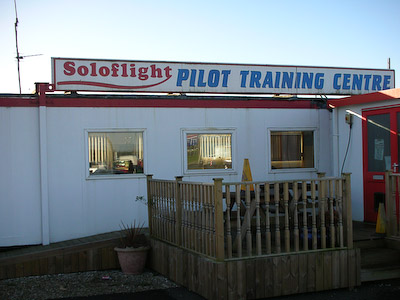
Soloflight ClubHouse

On arrival at the club Richard my instructor immediately tuned the club radio into the ATIS. The weather had not changed and visibility was still 5000 metres. Still we decided to head out over to the west and practice my general handling skills; get my hand in so to speak.

Leaving the club house I walked over to the security office and joined the queue! There seems to be a large body of air cadets going through. After signing in I asked the guard about my digital camera. Could I just carry it through the scanner or did it have to go through the x-ray machine. They told me to put it through the x-ray with my flight bag.

Romeo Lima was parked on the apron, but just past the security office a helicopter was performing its power checks, I gave it a wide birth and the pilot gave me a quick wave. Romeo Lima was the only plane on the apron so not hard to spot. I climbed up on the starboard wing and opened up the door and put my flight bag on the co-pilots seat as usual. Grabbing my check list, knee board and headset, I put the latter two on the back seat with the bag and started working through the check list.

Romeo Lima

I had hardly started when Richard appeared. He went straight to the fuel tanks and checked their contents, there was some concern that one tank might be a lot fuller then the other causing some imbalance.

With the first checks complete and the engine running I called for clearance and as usual was cleared to holding point Bravo. Once there I went through the power checks but gave extra carb heat. With the temperature and dew-point so close carb freezing was a definite risk, I did not want the engine failing during take off!

Take Off
It was time to call for clearance.
“Humberside Tower, Solo02, Ready for take off”

“Solo02 cleared to line up runway 21”

Reducing power, I took off the hand brake and then swung the plane round and lined up on runway 21. A few moments later I was given my transponder code and cleared to take off with a right hand turn out.

Heading away from Humberside we were handed over to Radar. I retuned the radio and announced my presence.
“Humberside Radar, Good morning. Solo02 passing 1400 to 2500 feet, request flight information service.”

“Solo02, Barnsley QNH1036, Flight Information Service.

“QNH 1036, Flight Information Service, Solo02.”

With that taken care of I continued my climb to 2500 feet and leveled out. First it was time to try a few gentle turns. 15 degree left then right, then 15 degrees of bank to the right. Then slightly steeper turns, 30 degree banked turns to both left and right.

Now for a little trimming practice. Raising the nose, and trimmed for a 70 knot cruise. With this done I lowered the nose and trimmed for a 130 knot cruise, this I found slightly harder. It was while trimming and adjusting the power for the slow cruise that Radar warned me of an aircraft closing to my left at 3000 feet. I started looking out while trimming the aircraft to 70 knots. Once I had achieved a stable 70 knots I finally spotted the aircraft to my left slowly overtaking me and also slightly converging on my path. While the pilot had reported himself to be cruising at 3000 feet he looked almost level, as he drew up to my position he changed course slightly to continue parallel to my path and started to climb upwards, back to the 3000 feet he should have been at! Its all too easy to let your speed or altitude change from what it should be. Often I have found myself to be 200 feet too high or too low; or 10 knots too fast or too slow. It is something that I am much more aware of now but still it sometimes catches me out.

Once I had once again got the hang of trimming I decided to try some serious turns! Banking 45 degrees, increasing the power, and pulling back on the yoke to stop us entering a spiral dive; around the plane spun. Pirouettes to the right and then to the left, round we spun. Fun in one direction but for some reason it always makes me feel sick in the other.

Rejoin
The mist was still around but there was a chance that Humberside might allow me to make a few touch and goes to practice my landing technique. Looking around I spotted the Humber bridge and from that worked out the general direction of the airport.
“Humberside Radar, Solo02 request rejoin via Elsham.”
Radar acknowledged my request. Eventually I spotted Elsham in the distance and headed towards it. As I approached, Radar handed me over to Humberside Tower together with the QFE which I immediately set on the altimeter. Thanking them I tuned the radio into the ATIS and checked the weather. Still only 5000 metres visibility but it did not look too bad now. I retuned the radio again, this time to the tower frequency.
“Humberside Tower, Good morning this is Solo02, approaching Elsham.”

“Good ‘afternoon’, Solo02 Cleared to final runway 21 via right base”.

I made a quick note about right base and started looking out for the runway. I soon spotted it and made my approach via right base.

Checks done, carb heat on and a slow decent started, Richard my instructor got back on the radio and asked if instead of landing we could perform a touch and go. As they could now clearly see us they agreed despite the weather.

Turning on to final I reported my position and was cleared for a touch and go. I was a little high so I put in three stages of flaps and down we came for a perfect landing. Off I took again.

Romeo Lima

On the downwind leg we asked if we could do a another touch and go. The Tower said yes so off round we went again.

After this second touch and go we went round once more and this time landed. All landings were perfect. The approach of the first two was a little poor, bad height control but the third was spot on.

Altogether a great session. Now I am off on Holiday. But when I come back its down to some serious training, more solo time and its time to learn navigation. Off to the book shop I think for my next training manual!