A bit of phoning around and re-jigging of schedules resulted in me managing to get a lesson booked this Saturday. Big thanks to Sandra and Stewart in changing there schedules in order to fit me in.
The weather was not looking good all week, but Saturday was looking to be the best of all. There was a good change I would be flying. Stewart suggested I do the Full Sutton trip again but SOLO!
I practiced the planning every night with that days weather forecast, and even went as far as putting a leaflet on the living floor, pretending it was Full Sutton and walking round it, pretending I was the plane and practicing the radio calls and over head join!
Come Friday night I was better planned then I had ever been, I looked forward to good weather.
Six o’clock on the dot, I was up and downloading the weather, checking the METAR; things looked good:
EGNJ 120650Z 27010KT CAVOK 01/M01 Q1000
CAVOK, wow. I downloaded and printed out the forecasted weather on form F215 and also the spot winds form F214. My navigation calculations did not take long and I filled in my plog that I had already prepared. Wind was only 290 degrees at 13 knots according to my calculations at my planned flight attitude so my heading was not that much different to the planned track.
After breakfast and reading the NOTAM’s I defrosted the car and headed off. The only issue I could see was the ice; freezing level was only 2000 feet.
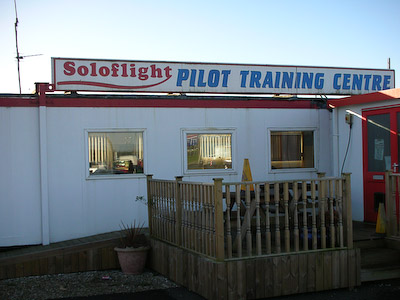
Arriving at Soloflight, Stewart checked all my calculations, plog, and track I had drawn on the map. All was good, so after a reminder about ice and its effects, brief on landing on the damp grass runway at Full Sutton then I was off on my own.
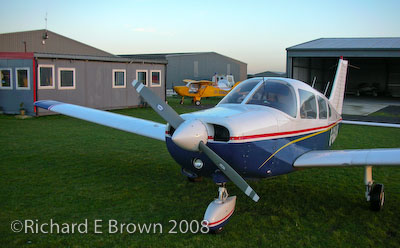
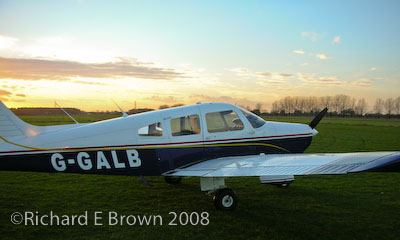
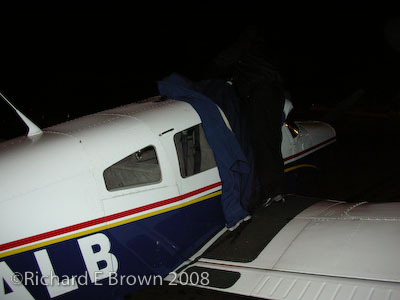
First job was to uncover the plane. It would be G-GALB again for my trip. I took the frozen and stiff cover off and put it away in the back and proceeded with the full ‘A’ checks.
Engine started and other checks out of the way I tuned the radio to the ATIS on 124.125 and took down the details.
Information was Tango, Runway 21 with a QNH 1002 and a wind of 220 degrees at 11 knots. I called up Humberside Tower on 124.9 and asked for a radio check and taxi. Readability was 5 and I was cleared to holding point Bravo. While sending and receiving on the radio was fine I was getting a lot of background noise while not receiving or sending which was odd.
I took off the brake and increased the power, as we started to roll I gave it full left rudder to swing round before I hit the jet provost parked in front of me. Before rolling to far, I reduced the power to minimum and tried the brakes; good so then a swing to the left and right to check that the DI was working. With that done I headed for holding point Bravo to do my power checks. I was still getting a lot of back ground interference on the radio so asked for another radio check while altering the radio squelch, better but not as good as normal. I wondered what I was doing wrong. Still I could hear the tower and they could hear me perfectly. Just a lot of static when not transmitting or receiving.
Once all the checks were finished I, declared “Golf Golf, Apha Lima Bravo, ready for departure”.
I was cleared to line up so I did so, then I was given a transponder code of 4267, which I set, and then was cleared to take-off.
I took off the brakes and set full power. I gave it plenty of right rudder to keep us straight and checked the engine oil pressure and temperature, making sure I still tracked the centre line (they only de-ice the centre of the runway!) I made sure the speed was climbing. Much faster then normal we had 60 knots and I was airborne. I let the speed climb to 80 knots then set the attitude for the normal climb. I soon made a right turn as instructed and continued my climb.
As was usual for me, I had planned my route from Elsham, so headed there. Tower handed me over to Radar so I changed frequencies.
“Humberside Radar, this is Golf Golf Alpha Lima Bravo, passing 1400 feet to altitude 2000 feet, request Flight Information Service.”
This was given and I checked the DI and against the compass. I then grabbed my map to check exactly were I was. I looked up to check were the Humber bridge and saw nothing, Oh Damn! What had just happened. Cloud. How had that happened. I immediately turned on the carb heat and reduced the power all the way. Keeping a close eye on the artificial horizon I suddenly dropped into the clear. Carb heat off, power back to 2300rpm to hold us steady and I had a careful look round.
It still looked quite good but there was cloud coming in from the direction I was heading about 2000 or 2500 feet. Below that was a thin wispy layer that I had just run into. It was very difficult to see. I increased the power to start my climb again. I got up to about 1600 feet and visibilty started to drop again, I immediately dropped down to 1500 and considered the situation.
To the north it was clear blue sky and it was suppose to continue clearing but currently it was not good. I checked my position and I had moved far to the right of my track. I made a correction to get me back on track and tried to gain some attitude once again.
I got up to about 1700 feet this time as I headed north west, which was better, but I did not feel happy. I had a look round behind me and I could hardly see a thing. The low sun in the east towards the airport combined with the wispy cloud meant I could not see any ground features in that direction at all.
OK. Command decision to make. Weather behind me going down hill, weather in front not that good. Whats that saying amongst pilots. Better to be on the ground wishing you were in the air and not the other way round. Well I was getting nervous now and while I felt I was being a failure I knew better to be safe then sorry. It might all clear if I went on but it might get worse.
I turned around and heading in the general direction that I thought the airport was in. Now I was pointing this way the sun and hazy made the visibility extremely poor, this was going to hard work. I got back on the radio and announced my intention to return and why. To improve my navigation I started a slow descent in order to better read the ground features. By about 1200 feet I could see better but not the airport.
Radar handed me over to the Tower who gave me a right base approach and announced I was number one. I dropped to 800 feet to give me better visibility and joined what I hoped was right base. Suddenly the runway appeared very close on my near right. I put in the carb heat reduced all the power and let the speed fall to 80 knots, then with two stages of flap set I made a careful turn to line up with the runway, keeping a very careful eye on my airspeed. A gentle set of ‘S’ turns set me up and I made a gentle landing a little long as my final was so short but not a issue as Humberside’s runway 21 is very long. On a short strip I would have had to make a bad weather circuit.
I parked up and Stewart met me, and helped me put the covers back on the plane. Back down on the ground the weather looked lovely and I could just see blue sky but that band of darker low cloud in the direction of Full Sutton.
I explained to Stewart what my problem had been and he said that it can be very difficult judging what the real conditions are like from the ground.
I felt somewhat a failure for not making the trip and the weather looked great from the ground. But I was the captain and it was my decision to make.
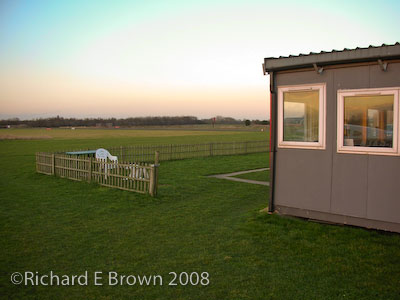
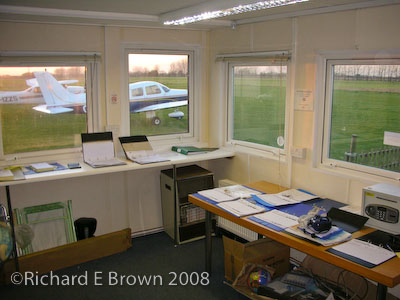
Back at the club house I added half an hour to my log in the P1 position and discussed what what we needed to do. I would try again in two weeks, and was also reminded I needed to get on and finish my exams. According to Stewart my flying is very good and I could end up having to wait before I can take my test because I have exams left. I also discussed my issue with the radio and he thought I might have had the ident set and turned up which interfered with the radio.
At the moment I certainly don’t feel like a pilot today. I really struggled and found the work load extremely high. The important thing was I flew the plane and got myself and Lima Bravo back safe.
It was another lessoned learned.